First phones
What age should a child get a phone? A UK parent's guide

Most parents arrive at this question with a deadline in mind: a walk to school, the move to secondary, a friend who’s just got one. The honest answer is that nobody in the UK sets a right age. What you can do is look at what most families do, what schools and the official bodies say, and then decide for your own child.
Is there an official right age for a child to get a phone?
No. There’s no UK law, and no government department or health body, that says when a child should have a phone.
The NSPCC says there are no exact rules about the right age to give a child access to technology: every child is different and will mature in their own time. For children with special educational needs, it suggests thinking about the right age and stage for your child, based on the level of support they need.
The UK Chief Medical Officers looked at the research in 2019 and found it wasn’t conclusive enough to set evidence-based limits on children’s screen use. They were careful to add that a lack of evidence isn’t proof that there’s no harm, and gave precautionary advice instead: keep phones out of bedrooms at night, keep mealtimes screen-free, and take a break after a couple of hours. That commentary hasn’t been formally updated since.
When do most UK children get their first phone?
Around the move to secondary school. Ofcom’s Children and Parents report, published in May 2026, found that phone ownership jumps from 56% of 10-year-olds to 83% of 11-year-olds. Across all 8–17-year-olds, 78% have their own phone, and by 16–17 it’s 98%.
That’s a picture of what families do, not a recommendation. Plenty of the 10-year-olds without a phone are in families who’ve chosen to wait, and plenty of the 11-year-olds with one have a phone set up with tight limits.
What do schools, MPs and regulators say?
Each has a view on part of the question, but none of them answers it for you.
- Schools (England). The Department for Education first asked schools to stop phone use during the school day in February 2024. Its guidance was revised in January 2026 and became statutory in June 2026, for schools to follow from September 2026: schools should be mobile phone-free by default, with no phone use for the whole school day, breaks and lunch included, and the Children’s Wellbeing and Schools Act 2026 requires schools to have regard to it. So in England your child’s phone will usually stay away during the school day, but the guidance says nothing about whether they should own one. Scotland, Wales and Northern Ireland set their own policies.
- MPs. In May 2024 the House of Commons Education Committee recommended that the next government consult on measures including a total ban on smartphones for under-16s, and consult on whether to raise the age at which children can agree to apps using their data from 13, suggesting 16. No smartphone ban followed. Instead, in June 2026 the government announced that social media will be banned for under-16s, with the ban expected to take effect from spring 2027; exactly which services are covered will be set in regulations.
- The regulator. Under the Online Safety Act, Ofcom’s children’s codes have been in force since 25 July 2025. Sites and apps must use highly effective age checks to keep children away from the most harmful content, such as pornography and material promoting self-harm, suicide or eating disorders. That makes the internet safer at the platform end, but the rules are new and platforms are still adjusting to them.
The evidence is genuinely contested. The Education Committee saw enough to call for a smartphone ban to be considered; the Chief Medical Officers found the research too inconclusive to set limits. Both are reasonable readings of the same uncertain picture, and your family’s choice can sit anywhere between them.
What is the smartphone-free childhood movement?
It’s a parent-led campaign, Smartphone Free Childhood, that started in 2024. Its Parent Pact asks parents to wait until at least the end of Year 9, around age 14, before giving their child a smartphone, and until 16 for social media.
The point is doing it together. One family holding out alone can leave a child feeling left out; if most of a class has signed, nobody is the only one without. Schools across the country have shared the pact with parents, though it isn’t school or government policy and signing is a personal choice.
Note what it’s about: smartphones and social media, not staying in touch. Waiting for a smartphone doesn’t have to mean waiting to stay close to family and friends.
Is a phone the same as a smartphone?
No, and it’s the most useful distinction in the whole decision. Internet Matters says primary-age children don’t need a connected device with unrestricted access to apps and games, and that a basic phone — calls and texts, no internet — is a good fit at that age.
| Basic phone | Locked-down phone | Full smartphone | |
|---|---|---|---|
| Calls and texts | Yes | Only with a SIM (many run on Wi-Fi alone) | Yes |
| Web browser | No | Switched off | Yes |
| Social media | No | Only what you allow | Yes, subject to age limits |
| Messaging friends | Texts only | Only through the apps you allow | Any app |
| Who manages it | Nothing to manage | You, from your own phone | Your child, with whatever limits you set |
A locked-down phone is often one you already own: an old iPhone or Android phone, erased and set up as a child’s phone so its parental controls are on from the start. Our guides cover that for an iPhone and an Android phone.
How do I decide when my child is ready?
Start with what the phone is for, then ask whether a smaller step would do. These questions help:
- Why do they need it now? A new journey, an after-school club, time between homes, a grandparent they’d like to talk to. A specific reason points to a specific kind of phone.
- Are they walking to school or travelling on their own? Being able to reach you is the most common reason, and a basic or locked-down phone covers it.
- How do their friends make plans? If arrangements happen in group chats, a child with no way of messaging can miss out. Talk to other parents in the class: what they’re doing, and whether they’d wait with you.
- Can they look after it? Charging it, keeping it in their bag at school, telling you if it’s lost.
- Would they tell you if something upset them? That conversation matters more than any setting.
- What will the rules be? Where it charges at night (the Chief Medical Officers suggest out of the bedroom), mealtimes, and what happens if the rules are broken. Agree them before the phone arrives, not after.
It helps to go through these questions with your child. Whatever you decide, it can change: starting small and adding more later is easier than taking things away.
How can my child stay in touch before they have a smartphone?
Easily. Friendships and family closeness don’t need to wait for a smartphone.
- A shared family tablet or computer at home. For under-10s, the NSPCC suggests devices with limited features, such as tablets without data and non-smart phones that only allow calls and texts.
- A basic phone for calls and texts with you and a few saved numbers.
- An old phone, locked down, with a messaging app that only reaches people you’ve approved.
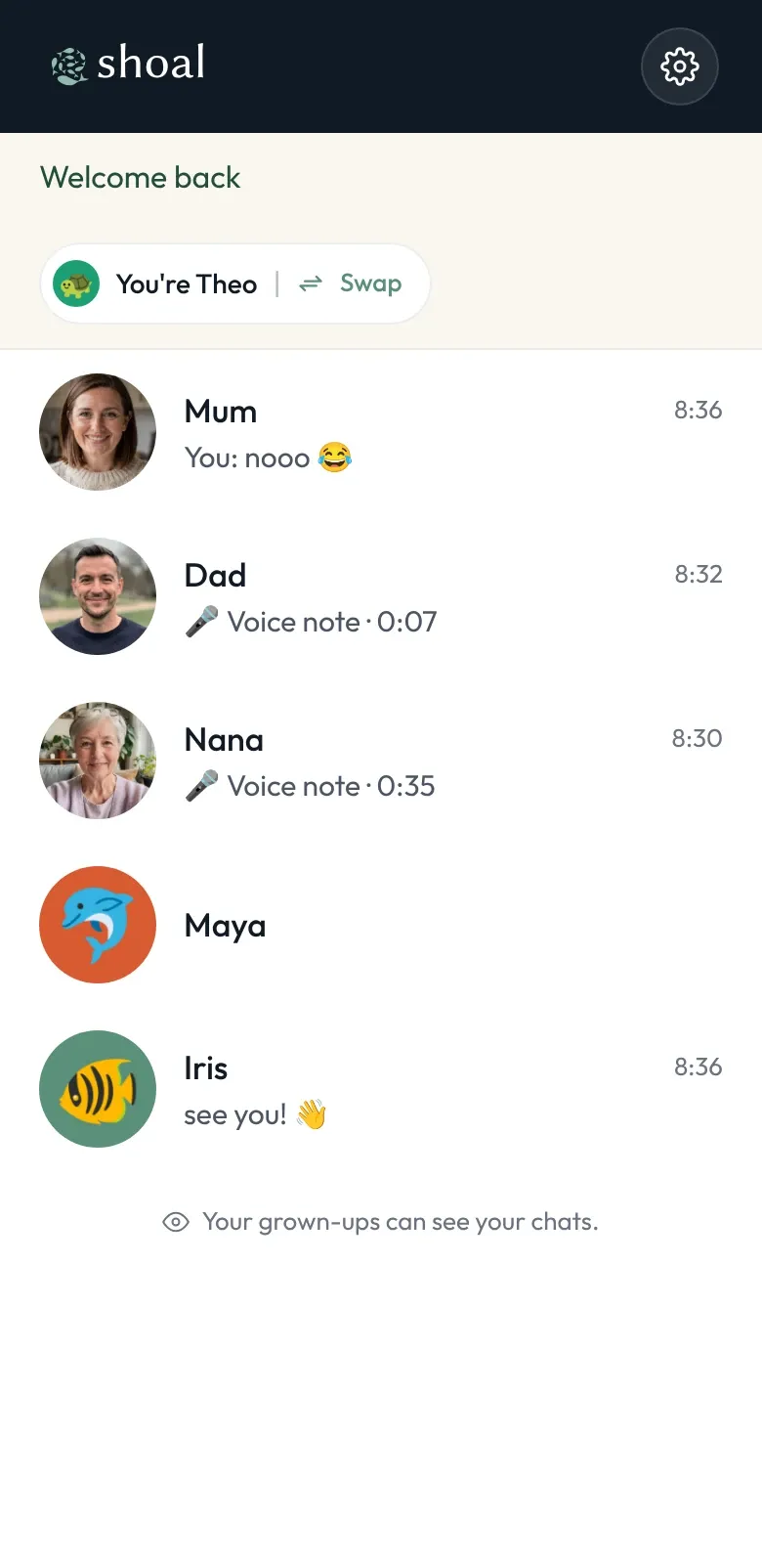
That last option is what Shoal is built for. Your child needs no email address or phone number: you add them by name, set up the phone as a family device, and they tap their name to start. They can message only the family you’ve added and friends you’ve connected them with — each friendship approved by a parent on both sides. You can read their chats, and active hours — when chat is open — are on by default. There’s more in a smartphone-free childhood, without skipping the messaging, and for children who’ve just started walking home alone, first steps of independence.
Whatever you choose, the aim is the same: a child who can stay close to the people who matter to them, on a phone that fits their age, while the bigger decisions wait until they’re ready.
Sources
Checked against these official guides in October 2026. Menus change between software versions, so if a step doesn't match your screen, they'll have the current wording.
- Ofcom: Children and Parents: Media Use and Attitudes report (2026)
- Ofcom: Younger phone owners, the rise of AI, and consumption over creation (2026)
- Department for Education: Mobile phones in schools (statutory guidance, 2026)
- Children's Wellbeing and Schools Act 2026, section 36: Guidance on use of mobile phones etc in schools in England
- House of Commons Education Committee: Screen time: impacts on education and wellbeing (2024)
- UK Chief Medical Officers: Commentary on screen time and social media (2019)
- Ofcom: Online age checks must be in force from tomorrow (2025)
- House of Commons Library: Proposals to ban social media for children (2026)
- NSPCC: Children and technology: age-appropriate usage advice
- Internet Matters: A smartphone-free childhood? Phone safety tips