TL;DR
Telegram is built for communities and broadcasts; Shoal is built for families. Neither encrypts every chat end to end, and we’d rather say that plainly. Telegram’s ordinary chats are encrypted between your device and Telegram’s servers, which hold the keys and can read them; only opt-in “Secret Chats” — one-to-one, and only on the device that started them — are end-to-end (its calls are end-to-end too). Shoal encrypts every message on the sending device and stores it as ciphertext it doesn’t decrypt in normal operation — but Shoal holds the keys, because that’s how parents can see their children’s chats. The bigger difference is who you can meet: on Shoal, only people a parent has approved.
What Telegram does well
Telegram is genuinely impressive in scope. Groups of up to 200,000 members. Channels for one-to-many broadcast. Files of up to 2 GB each (4 GB with Telegram Premium). Message scheduling, polls, bots, custom themes, and ordinary chats that sync across all your devices. For users who want a feature-rich communicator that handles communities and broadcasts as well as direct messages, Telegram has a lot going for it.
Where Shoal is different
Stored as ciphertext, every conversation. Every message, photo and voice note in Shoal is encrypted on the sending device, in every conversation including groups, and stored as ciphertext that we don’t decrypt in normal operation. It isn’t end-to-end — Shoal holds the keys, and the security page explains exactly what that means — but there’s no setting to remember.
Family scale, not crowd scale. Shoal isn’t trying to host groups of 200,000 strangers. The product is structured around small, persistent groups of people who actually know each other.
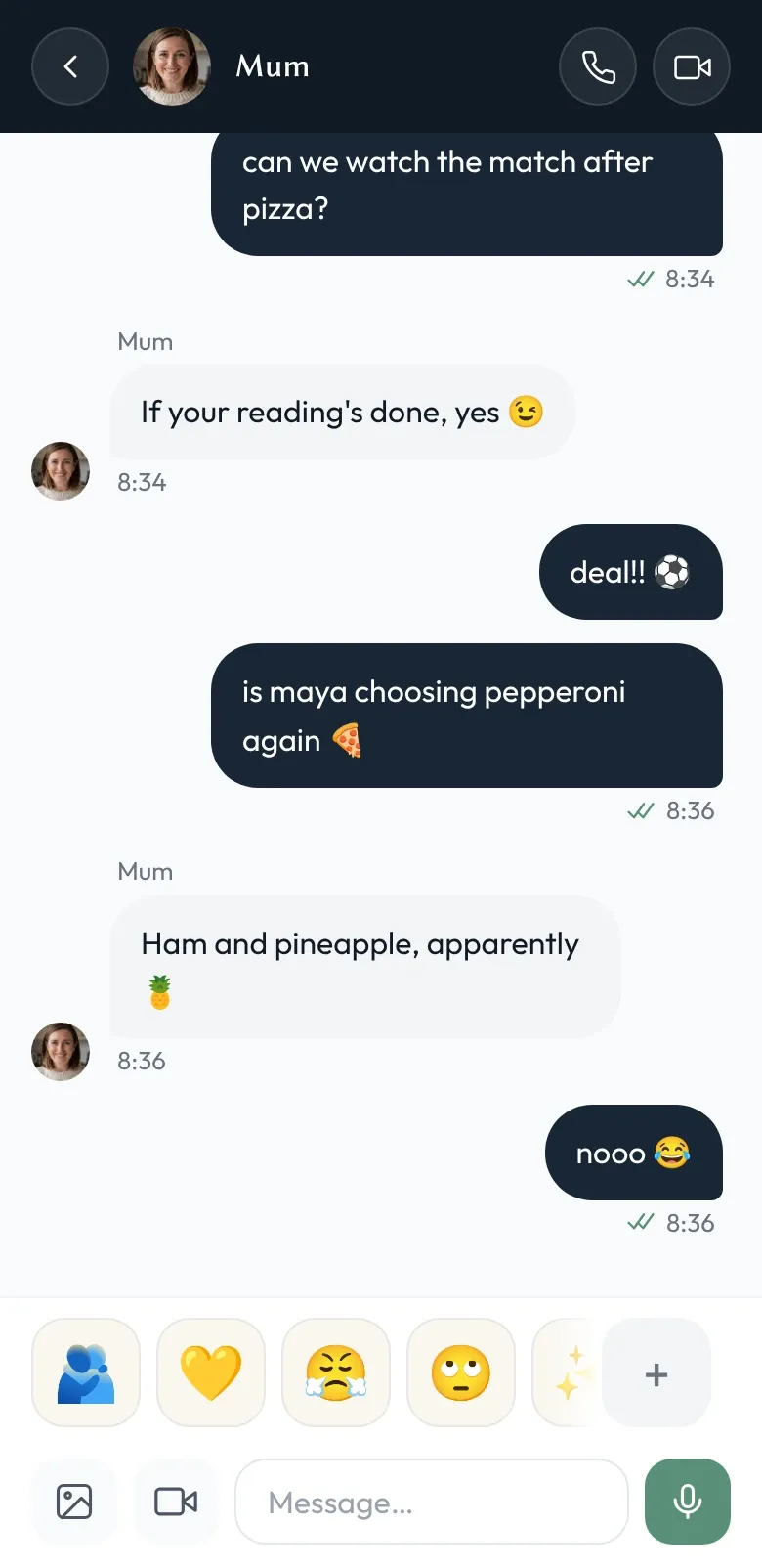
No discovery of strangers. Telegram’s design encourages discovery — public channels, joinable groups, bots that surface content. Shoal has none of that. The only people in your conversations are people a family admin (usually a parent, but could be any adult you trust) has explicitly added or approved.
Made for children, not just allowed. Telegram’s terms say users in the UK must be at least 18 to sign up. Shoal is built for children from the start, with the adults in their family alongside them.
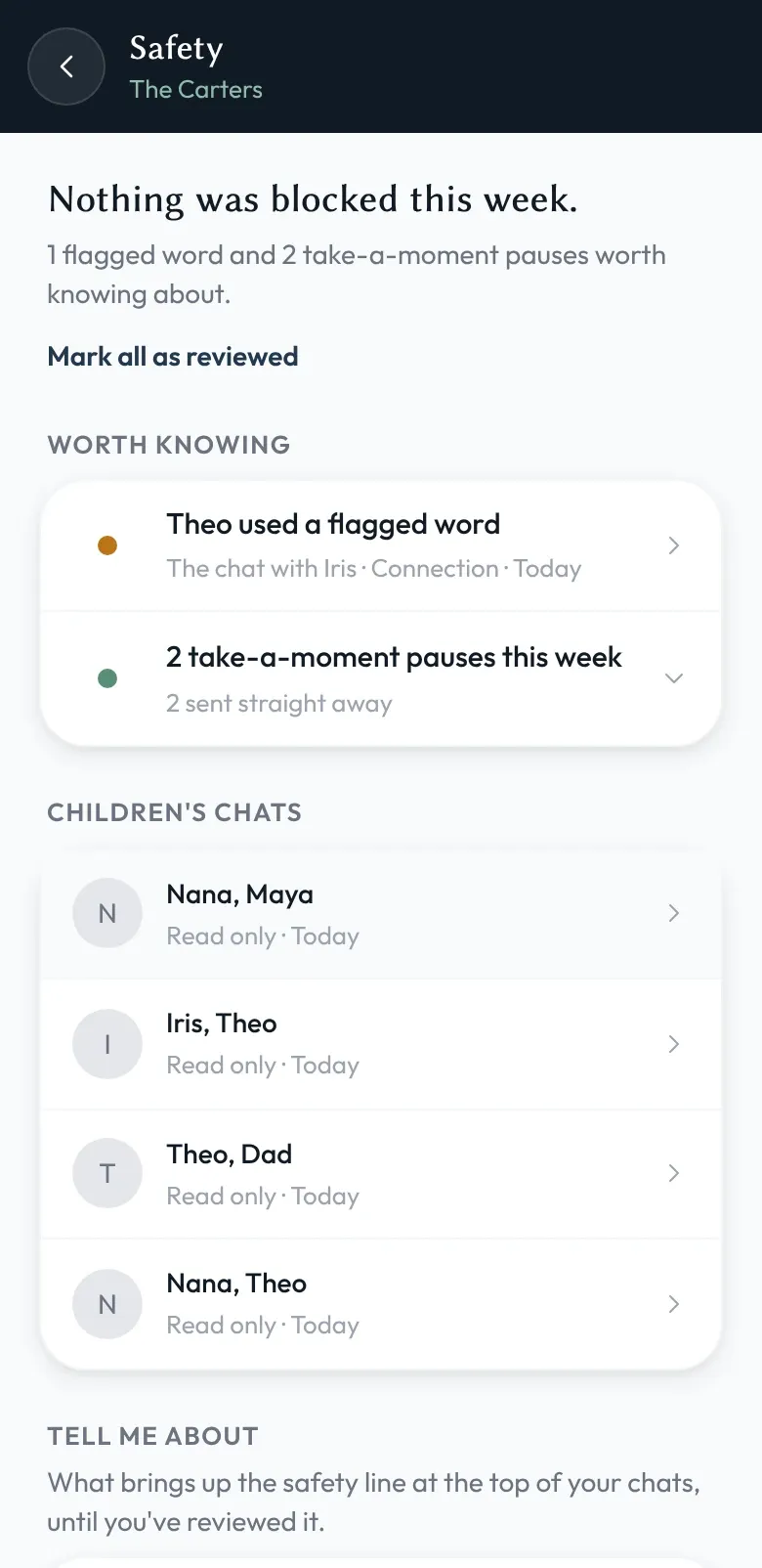
Family admin oversight. Telegram has no equivalent of Shoal’s built-in admin oversight for children. Phone-level tools such as Apple’s Screen Time or Google Family Link can limit or block the app, but they don’t show you who your child is talking to or what’s said — and Telegram itself doesn’t model families.
Side by side
| Shoal | Telegram | |
|---|---|---|
| Stored as ciphertext the service doesn’t decrypt in normal use, every chat | Yes (though Shoal holds the keys) | Only in Secret Chats (one-to-one, not groups) |
| End-to-end encrypted by default | No — Shoal holds the keys (see /security) | No for messages; calls are end-to-end |
| Public channels / discovery | No | Yes |
| Family-aware structure | Yes | No |
| Parental oversight built in | Yes | No |
| Phone number required | No | Yes |
| Minimum age in the UK | None (a parent adds the child) | 18 |
| Owner | Independent UK company | Telegram Group Inc. (British Virgin Islands); the app comes from Telegram FZ-LLC, Dubai |
When to pick which
Pick Telegram if you need huge group chats, public channels, large file sharing, or bot-driven workflows. Telegram is a tool for that kind of audience.
Pick Shoal if your communication is specifically about your family, you want every conversation stored as ciphertext without thinking about it, and you want an app that doesn’t shade into broadcast and discovery.
Telegram is a trademark of its owner. We have no affiliation with Telegram.